Exploring the diffusion and adoption of drone delivery services: A bibliometric analysis of Scopus and Web of Science
Bài báo nghiên cứu "Exploring the diffusion and adoption of drone delivery services: A bibliometric analysis of Scopus and Web of Science" do Châu Phương Trang (Trường Đại học Công nghệ Thành phố Hồ Chí Minh) thực hiện.
Abstract:
This study employs a bibliometric approach to examine the evolution and intellectual structure of research on drone delivery adoption and acceptance. A systematic search of the Scopus and Web of Science Core Collection databases was conducted on June 10, 2026, using predefined search criteria. Of the 317 records initially retrieved, 124 duplicates were removed, yielding a final dataset of 193 unique publications. Bibliometric analyses of publication trends, keyword co-occurrence, emerging research themes, and international collaboration patterns were performed using R and the bibliometrix/Biblioshiny package. The findings indicate a marked increase in scholarly publications since 2023. The field's conceptual foundations are predominantly centered on user acceptance, attitudes, behavioral intentions, perceived risk, innovativeness, trust, and the Technology Acceptance Model (TAM), whereas organizational adoption and readiness have received comparatively limited scholarly attention. These findings highlight a significant gap between individual- and organizational-level perspectives in the existing literature, underscoring the need for further research into the interplay between individual acceptance and organizational adoption of drone delivery services, the externalities affecting local communities, and the influence of regulatory environments on adoption decisions.
Keywords: drone delivery, technology adoption, user acceptance, last-mile delivery, bibliometric analysis.
1. Introduction
Drone delivery evolves from the experimental stage to a credible last-mile solution. The operational and environmental potential depends on routing, coordination of vehicles and drones, load, distance, and energy requirements but does not come naturally (Murray & Chu, 2015; Goodchild & Toy, 2018; Stolaroff et al., 2018; Macrina et al., 2020). Therefore, the issue of acceptance of commercialized drone delivery emerges alongside with practical implementation of drones. Civil-drone literature already raised the issues of privacy, safety, surveillance, and noise concerns (Finn & Wright, 2012; Clarke, 2014; Torija et al., 2020), and delivery studies focus on risk, trust, and legitimacy (Zhu, 2019; Zhu et al., 2020; Smith et al., 2022). Most studies on adoption are user-centered and use TAM or similar behavioral models (Yoo et al., 2018; Hwang et al., 2019; Choe et al., 2021; Waris et al., 2022). This study revisits the research area following its fast growth since 2023 by analyzing publication dynamics, conceptual core, topic shift, and international collaboration, paying special attention to visibility of organizational adoption.
2. Theoretical background and research methods
2.1. Theoretical background and literature review
Drone delivery research involves two streams: one is devoted to the operational issues of routing, service design, and environmental performance (Murray & Chu, 2015; Goodchild & Toy, 2018; Macrina et al., 2020), and another addresses the question of user acceptance and focuses on innovativeness, perceived benefits, risk, trust, and privacy (Yoo et al., 2018; Hwang et al., 2019; Osakwe et al., 2022; Xie et al., 2022).
TAM describes acceptance in terms of perceived usefulness and ease of use (Davis, 1989), and other theories (UTAUT and Diffusion of Innovations) extend this framework to performance expectations, facilitating conditions, and innovation attributes (Venkatesh et al., 2003; Rogers, 2003). Driven delivery literature often extends such models with specific service risks and benefits (Choe et al., 2021; Waris et al., 2022).
Risk includes privacy, surveillance, safety, and acoustic risks which also affect non-users in addition to users/customers (Finn & Wright, 2012; Clarke, 2014; Torija et al., 2020). Findings related to delivery specifically suggest that risk perception is structured and associated with acceptance rather than being one single risk (Zhu, 2019; Zhu et al., 2020; Xie et al., 2022).
The organizational level is under-researched. Business adoption requires resources, integration, adaptation to external context, and compliance. TOE framework is specifically intended to explain such business adoption decision-making (Tornatzky et al., 1990; Oliveira & Martins, 2011). Stakeholder theory explains why community and regulation concerns become relevant in the managerial decision-making (Freeman, 1984). However, the empirical literature on provider level adoption barriers remains sparse; at least until the research by Edwards et al. (2024).
The literature reviews also confirm this research gap. Cesur et al. (2022) identified a small empirical literature base consisting mainly of studies on intention, attitude, risk, innovativeness, and TAM. Atanda et al. (2026) mapped the broader landscape of drone delivery around the world. There is clearly a need for an up-to-date bibliometric mapping of the adoption research literature to determine whether the adoption literature research has gone beyond its early days.
2.2. Research methods
For these reasons, bibliometric mapping has been selected since it suits the purpose of tracing publication and conceptual structure of a dynamic area (Donthu et al., 2021). Data collection was done on 19 September 2026 from Scopus and Web of Science Core Collection (WoSCC) using the three conceptual blocks: drone/UAV terminology; delivery and last-mile terminology; and explicit adoption, acceptance, intention, or readiness terms. Scopus search used TITLE-ABS-KEY and WoSCC used TS. The searches yielded 172 and 145 articles, respectively. Articles were collected, harmonized, and merged in R 4.5.1 with bibliometrix 5.5.0 (Aria & Cuccurullo, 2017); 124 duplicates were deleted, leaving 193 unique documents. Because of differences in citation references formats between two databases, co-citation and bibliographic coupling could not be applied. Instead, the study focuses on annual production, keyword frequency and co-occurrences, Trend Topics, and countries' collaboration.
Table 1. Data retrieval and integration process

Source: Authors' own analysis using data from Scopus and WoSCC
Scopus search string: TITLE-ABS-KEY ((drone* OR UAV* OR "unmanned aerial vehicle*" OR "unmanned aircraft system*") AND ("drone deliver*" OR "last mile deliver*" OR "last-mile deliver*" OR "parcel deliver*" OR "package deliver*" OR "delivery service*" OR "delivery logistic*" OR "logistics service*") AND ("drone adoption" OR "drone delivery adoption" OR "UAV adoption" OR "technology adoption" OR "innovation adoption" OR "consumer adoption" OR "user adoption" OR "organizational adoption" OR "organisational adoption" OR "firm-level adoption" OR "adoption intention*" OR "intention to adopt" OR "adoption behavior*" OR "adoption behaviour*" OR "adoption decision*" OR "drone acceptance" OR "drone delivery acceptance" OR "UAV acceptance" OR "technology acceptance" OR "consumer acceptance" OR "user acceptance" OR "public acceptance" OR "social acceptance" OR "behavioral intention*" OR "behavioural intention*" OR "intention to use" OR "willingness to adopt" OR "willingness to use" OR "willingness to pay" OR "consumer readiness" OR "organizational readiness" OR "organisational readiness"))
WoSCC query used the same keywords but in TS field.
3. Results and discussion
3.1. Results
3.1.1. Publication growth
The specific corpus becomes apparent from 2018 onwards. The publications have risen from 3 in 2018 to 19 in 2021, dropped to 11 in 2022, then jumped to 22 in 2023, to 28 in 2024, and to 41 in 2025. Up to 19 September 2026, 47 publications had already been indexed for 2026. Since 2026 year is not complete yet, the last figure shows only the current momentum.
The speed-up after 2022 follows a general trend: early studies were focused on TAM, innovativeness, and behavioral intention, while recent studies were increasingly concerned with risk, privacy, and contextualized adoption (Yoo et al., 2018; Hwang et al., 2019; Xie et al., 2022; Li et al., 2024).
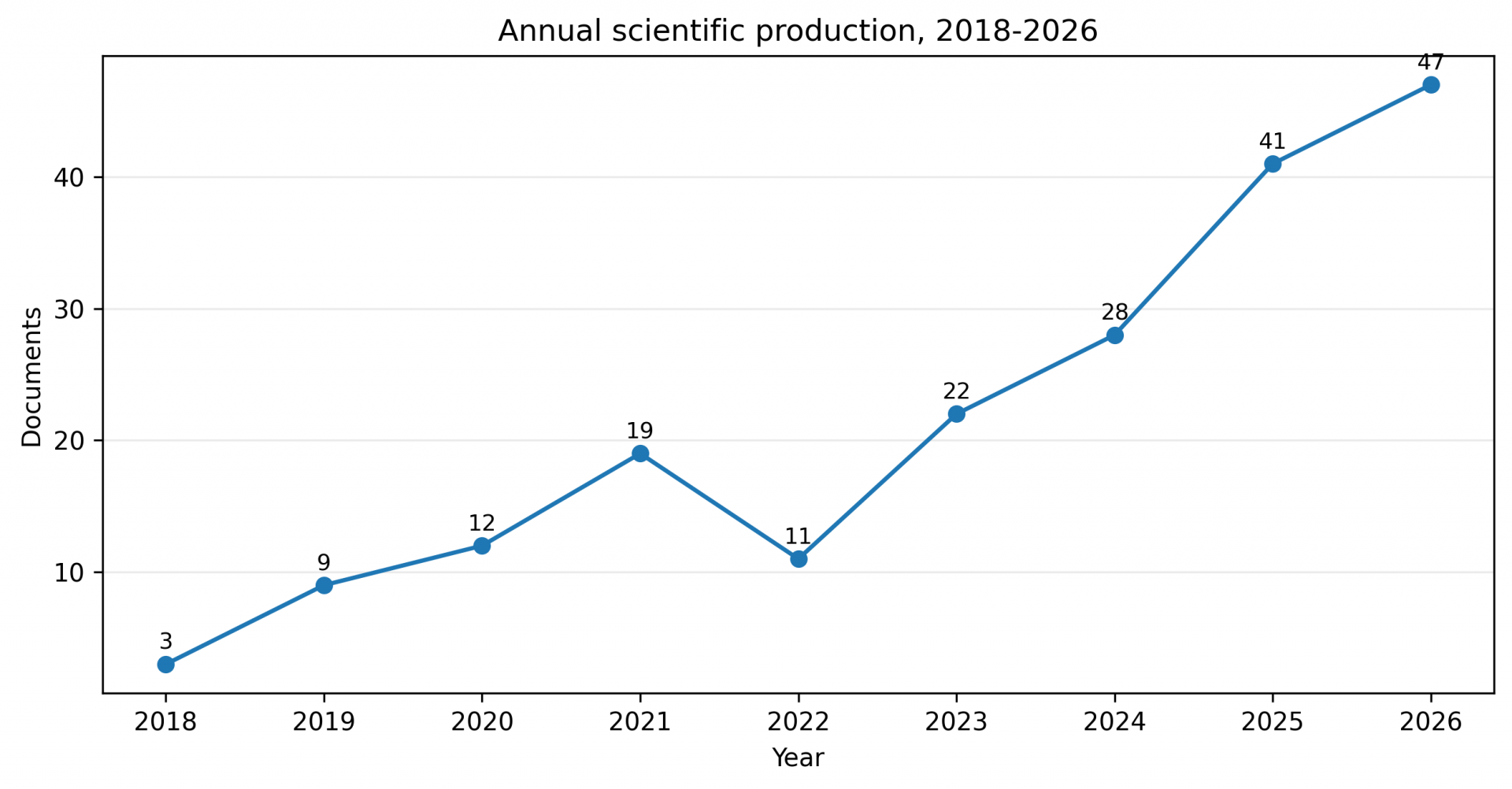
Source: Authors' analysis of Scopus-WoSCC merged database; data up to 2026 as of 19 September 2026
3.1.2. Prominent concepts
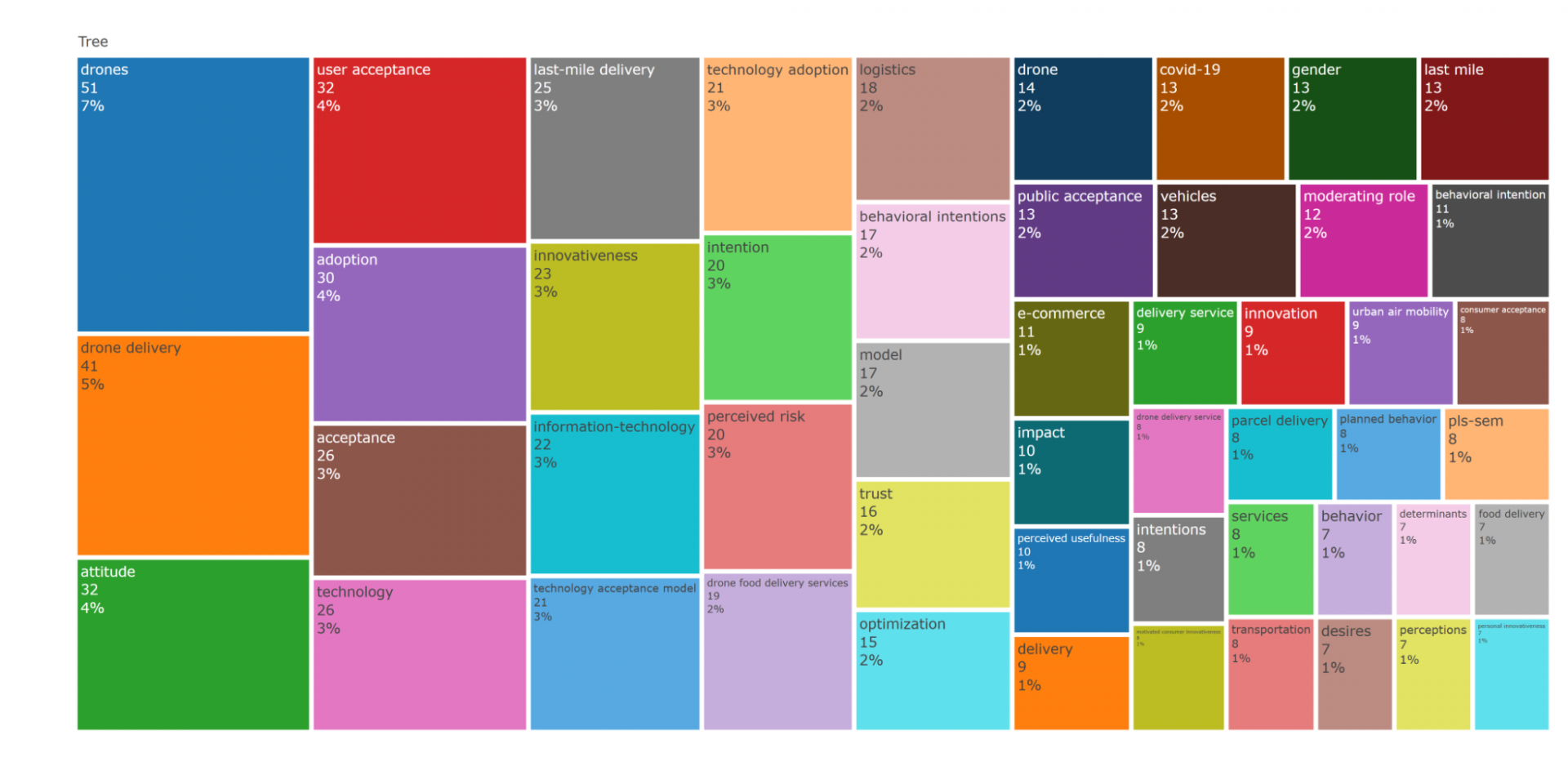
The conceptual structure of the TreeMap is largely shaped by adoption and acceptance-related words. The most frequently used are: drones (51); drone delivery (41); attitude (32); user acceptance (32); adoption (30); acceptance (26); technology (26); last-mile delivery (25); innovativeness (23); information-technology (22); technology acceptance model (21); technology adoption (21); intention (20); and perceived risk (20).
Three trends may be noted here. The concept of acceptance is currently as evident as the technology itself; TAM-related terminology is still prevalent; and operational words like last-mile delivery and logistics connect the behavior studies with the service system in which adoption takes place (Yoo et al., 2018; Hwang et al., 2019; Waris et al., 2022).
The organizational adoption and readiness are not the most common words. There are some provider-level studies (Edwards et al., 2024), but the conceptual structure that can be seen remains clearly more user-oriented than firm-oriented.
Figure 2. TreeMap of prominent terms in the corpus
Source: Authors' Analysis of Co-occurrence Network Based on Scopus and Web of Science Core Collection Data
3.1.3. Keyword co-occurrence structure
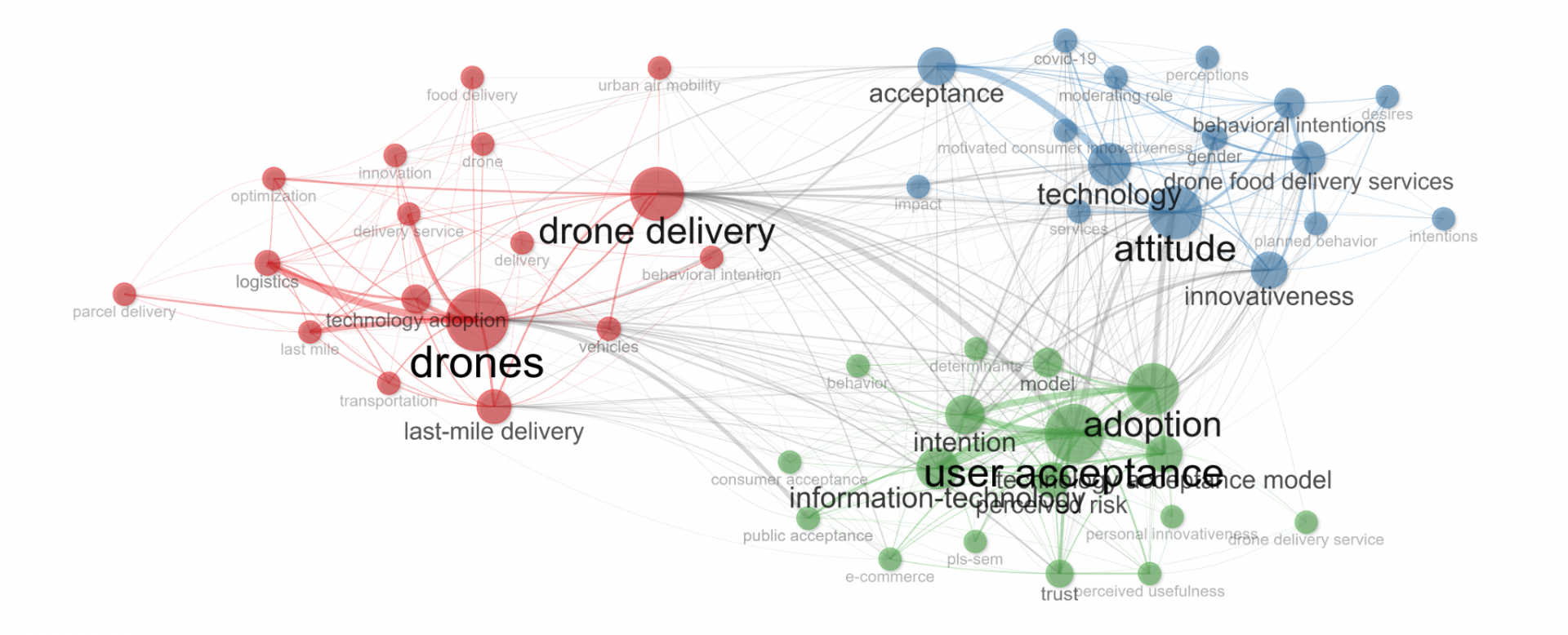
The co-occurrence network consists of three visually distinct but strongly interconnected clusters. The technology adoption vocabulary is common on the left side of the map, the user acceptance and adoption on the right bottom corner, and general technology and innovation on the right top corner of the map.
Several overlapping terms are present here, and the export file does not include the node-to-cluster assignment table, thus, the clusters are not named strictly. The appropriate description of the clusters is that the behavioral core is extended using risk, innovation and service context variables, which corresponds to the previous model extensions (Choe et al., 2021; Osakwe et al., 2022; Xie et al., 2022).
Figure 3. Keyword co-occurrence network
Source: Authors' Analysis Based on Scopus and Web of Science Core Collection Data
3.1.4. Temporal change of research themes
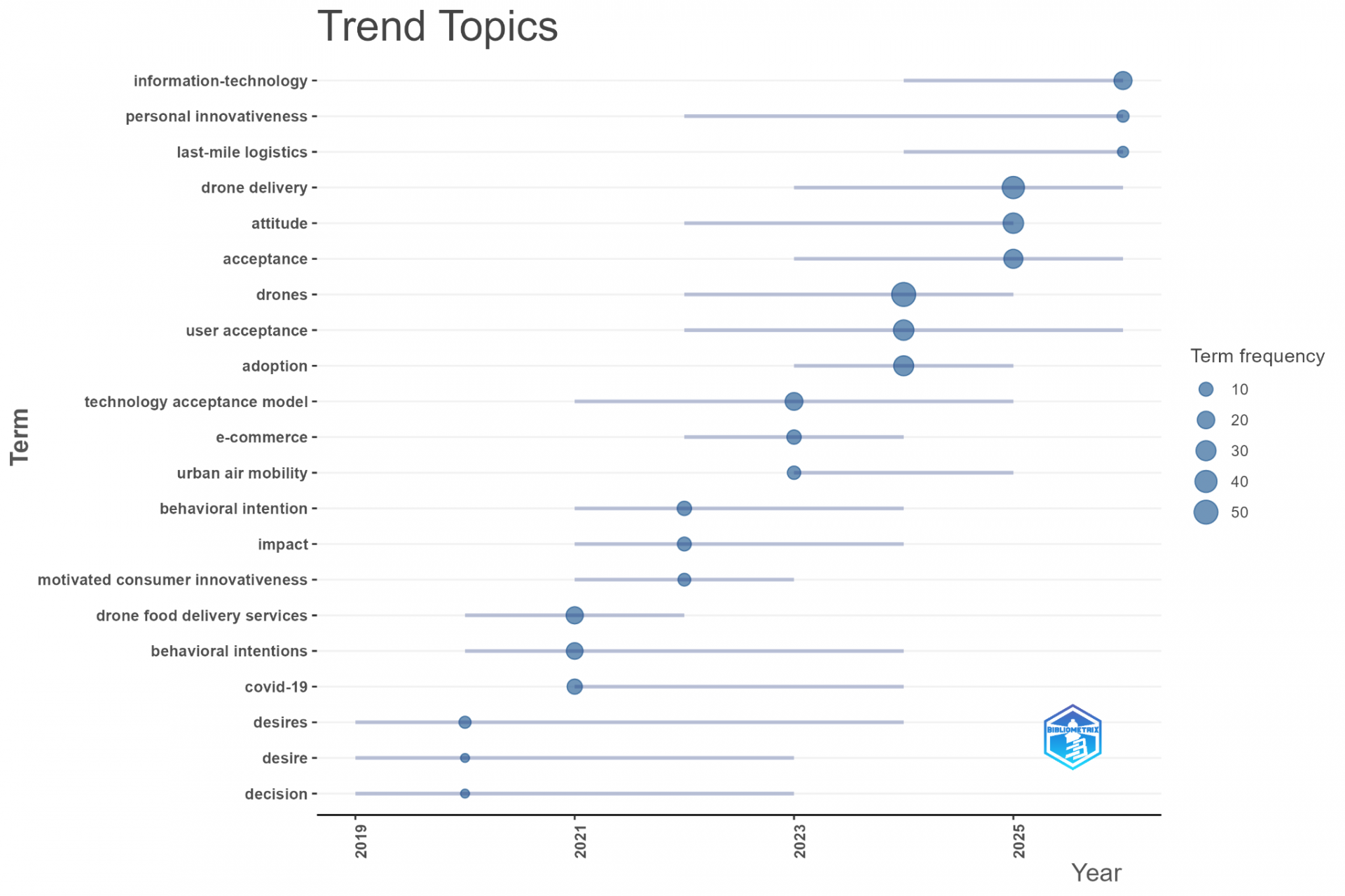
Trend Topics shows the temporal shift. Early papers are devoted to decision, desire, drone food delivery services, behavioral intentions, and COVID-19. In 2023, TAM, e-commerce, and urban air mobility gain their importance. During 2024-2025, the following themes are more prevalent: drones, user acceptance, adoption, drone delivery, attitude and acceptance. Last-mile logistics theme is valid till 2026.
The year shown is the period when the term had the greatest popularity, not the year of first usage. Despite that, the list demonstrates the tendency from pandemic-related, food delivery and intention studies towards more general issues of adoption and last-mile logistics (Hwang et al., 2020; Li et al., 2024; Kim et al., 2025; Wu et al., 2025).
Figure 4. Trend Topics over time
Source: Authors' analysis from Scopus and Web of Science Core Collection
3.1.5. International collaboration
This collaboration map highlights an international basis for research through co-authorship among researchers from North America, Europe, East and Southeast Asia, South Asia, and Oceania. Nodes of China and USA are clearly visible with some cross-regional connections.
However, the map is based on collaboration and not on research quality and location of studies. The geographical diversity of the map is still relevant as there are differences in regulatory, logistics and societal conditions in different countries and hence potential for comparative adoption research (Schmidt & Saraceni, 2024; Wu et al., 2025).
3.2. Discussion
The evolution of the field has not left its behavioral base behind. Even though the context of the research has moved towards last-mile logistics, user acceptance, attitude, intention, innovativeness, perceived risk, trust and TAM still occupy a central place. The relevance of such continuity at this point of time when large scale implementation of technology is yet to take off is easy to understand.
The limitation is theoretical rather than empirical since continuous addition of individual-level antecedents might provide diminishing returns when the problem moves from individuals to firms and institutions. These need investment, integration, regulation compliance, and operational accountability. TOE provides a better framework for conditions related to technology, organization, and the environment (Tornatzky et al., 1990; Oliveira & Martins, 2011).
However, risk involves more than individual inconvenience. Joint use can raise concerns about privacy, safety, surveillance, and acoustic externalities on behalf of non-users (Finn & Wright, 2012; Clarke, 2014; Torija et al., 2020). In the case of delivery services, these risks can become those of reputation, liability, community relations, and regulatory scrutiny (Zhu, 2019; Zhu et al., 2020; Smith et al., 2022).
This introduces a level-of-analysis issue. Whereas consumer acceptance is related to willingness to use the technology, firm adoption involves willingness to invest, integrate, operate, and continue using it. Stakeholder theory suggests that firms are not only driven by their customers but also regulators and communities (Freeman, 1984).
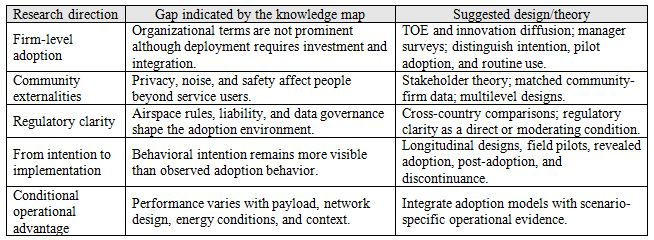
This temporal analysis implies that behavioral theory becomes increasingly entrenched within a context of deployment and not eliminated. Thus, the space emerges for cross-level theories where organizational readiness, operational advantage, community concerns, and regulatory clarity collectively influence the firm adoption process.
Future research should bridge levels of analysis. Community and managerial data can be collected to see whether privacy, noise, safety, and social reactions affect managerial assessment of risks while cross-country designs can be used to study regulatory clarity as an environmental condition.
Thirdly, the difference between intention and implementation deserves more attention. Research is supposed to differentiate between intentions to adopt, to test in pilots, to adopt permanently, and discontinuing.
Fourthly, operational advantage is conditional. The specifics of routing, payload, distance, energy constraints, and network design affect the benefits of drones in deliveries, and firm-level adoption models should condition relative advantage by these deployment scenarios (Murray & Chu, 2015; Goodchild & Toy, 2018; Macrina et al., 2020).
Table 3. Future research directions derived from the bibliometric structure
Source: Authors' synthesis and suggestions based on the results of bibliometric analysis
4. Conclusion
The analysis of 193 unique Scopus-WoSCC entries indicates that the adoption and acceptance of drone delivery systems have seen rapid growth since 2023. Conceptually, the focus has not shifted from user acceptance and is still concentrated around acceptance, attitude, intention, risk, innovativeness, trust, and TAM. Modern themes are getting closer to drone deliveries and last mile logistics.
The main contribution of this study is the identification of a level-of-analysis gap – firm-level adoption and readiness are less explored in comparison with user acceptance despite firms adopting drones for delivery purposes. Future research should explore the connection between operational advantage and firm readiness together with community externalities and regulation.
The results are limited due to the coverage of the databases, the methodology used, insufficiently reconciled keywords, and inability to conduct references analysis based on the merged dataset. The information on 2026 is also limited. Future full-text review or company-level empirical analysis may verify the mechanisms identified using bibliometric analysis.
REFERENCES:
Aria, M., & Cuccurullo, C. (2017). bibliometrix: An R-tool for comprehensive science mapping analysis. Journal of Informetrics, 11.
Atanda, A. F., Tan, D. Y. W., Ting, H. Y., Oyenuga, W. O., & Tosho, A. U. (2026). Research landscape of drone delivery globally: A bibliometric analysis. Acta Informatica Pragensia, Acta Informatica Pragensia 15(1):221-252. DOI:10.18267/j.aip.296.
Cesur, A., Yiğenoğlu, K., Aydın, İ., ve Çelik, Z.(2022). Drone Teslimatına İlişkin Deneysel Araştırmalar Üzerine Bibliometrik Bir Analiz.Yüzüncü Yıl Üniversitesi Sosyal Bilimler Enstitüsü.
Choe, J. Y., Kim, J. J., & Hwang, J. (2021). Innovative marketing approaches to constructing drone food delivery systems: Combining the theories of TAM and TPB. Journal of Travel & Tourism Marketing, 38(1), 16-30.
Clarke, R. (2014). Regulatory Impacts on Behavioural Privacy from the Deployment of Civilian Drones. Computer Law & Security Review, 30(3).
Davis, F.D. (1989). Perceived usefulness, perceived ease of use, and user acceptance of information technology. MIS Quarterly, 13(3), 319-3.
Donthu, N., Kumar, S., Mukherjee, D., Pandey, N., & Lim, W. M. (2021). How to perform a bibliometric analysis: An introduction and guidance. Journal of Business Research, 133, 28.
Edwards, D., Subramanian, N., Chaudhuri, A., Morlacchi, P., & Zeng, W. (2024). Utilization of drone deliveries in humanitarian missions: An analysis of obstacles in the adoption of delivery drones by logistic service providers using a technology acceptance model. Annals of Operations Research, 335, 164.
Finn, R. L., & Wright, D. (2012). Unmanned aircraft systems: Surveillance, ethics and privacy in civil applications. Computer Law & Security Review, 28(2), 184.
Freeman, R. E. (1984). Strategic management: A stakeholder approach. Pitman.
Goodchild, A., & Toy, J. (2018). Delivery by drone: An evaluation of unmanned aerial vehicle technology in reducing CO2 emissions in the delivery service industry. Transportation Research Part D: Transport and Environment, 61, 58-67. https://doi.org/10.1016/j.trd.2017.02.017.
Hwang, J., Kim, D., & Kim, J. J. (2020). How to form behavioral intentions in the field of drone food delivery services: The moderating role of the COVID-19 outbreak. International Journal of Environmental Research and Public Health, 17(23), 9117. https://doi.org/10.3390/ijerph17239117.
Hwang, J., Kim, H., & Kim, W. (2019). Investigating motivated consumer innovativeness in the context of drone food delivery services. Journal of Hospitality and Tourism Management, 38, 102-110. https://doi.org/10.1016/j.jhtm.2019.01.004.
Kim, Y., Wang, L., Noh, J., Li, X., Lee, G. J. X., & Yuen, K. F. (2024). Urban drone delivery acceptance by consumers: The effect of perceived anthropomorphism. Cities, 148, 10486.
Macrina, G., Di Puglia Pugliese, L., Guerriero, F., & Laporte, G. (2020). Drone-assisted routing: A literature review. Transportation Research Part C: Emerging Technologies.
Murray, C. C., & Chu, A. G. (2015). The flying sidekick traveling salesman problem: Optimal drone-assisted delivery of packages. Transportation Research Part C: Emerging Technologies, 54, 86-109.
Oliveira, T., & Martins, M. F. (2011). Literature review on IT adoption models at the firm level. Electronic Journal of Information Systems Evaluation, 14(1), 110-12.
Osakwe, C. N., Hudik, M., Říha, D., Stros, M., & Ramayah, T. (2022). Critical drivers of consumer intention toward drone-based last mile delivery: Does the delivery risk play a role? Journal of Retailing and Consumer Services, 65, 1028.
Rogers, E. M. (2019). Diffusion of Innovations. In book: An Integrated Approach to Communication Theory and Research (pp.182-186). Publisher: Mahway, MJ: Lawrence Erlbaum Associates. DOI:10.4324/9780203710753-35.
Schmidt, S., & Saraceni, A. (2024). Consumer acceptance of drones in logistics. Research in Transportation Economics, 103, 101404.
Smith, A., Dickinson, J. E., Marsden, G., Cherrett, T., Oakey, A., & Grote, M. (2022). Public acceptability of the use of drones for logistics: The current state of affairs and progressing to a better-informed discussion. Technology in Society, 68, 101883.
Stolaroff, J. K., Samaras, C., O'Neill, E. R., Lubers, A., Mitchell, A. S., & Ceperley, D. (2018). Energy usage and greenhouse gas emissions during the life cycle of drones for package delivery. Nature Communications, 9, 409.
Torija, A. J., Li, Z., & Self, R. H. (2020). The influence of a hovering unmanned aerial vehicle on the perception of urban soundscapes. Transportation Research Part D: Transport and Environment, 78, 102195.
Tornatzky, L. G., Fleischer, M., & Chakrabarti, A. K. (1990). The process of technological
Venkatesh, V., Morris, M. G., Davis, G. B., & Davis, F. D. (2003). User acceptance of information technology: Towards a unified view. MIS Quarterly, 27(3), 4
Waris, I., Ali, R., Nayyar, A., Baz, M., Liu, R., & Hameed, I. (2022). Empirical examination of customers’ adoption of drone food delivery service: An extended technology acceptance model. Sustainability, 14(5), 2922.
Wu, J., Chen, Z., Zhang, Z., & Cen, M. (2025). The investigation of acceptance on drone delivery service by Chinese consumers: A comparison between urban and rural areas. PLOS ONE, 20(9), e03.
Xie, W., Chen, C., & Sithipolvanichgul, J. (2022). An exploration of e-commerce consumer behavior in the utilization of drone-based delivery services: The privacy calculus perspective. Cogent Business & Management, 9.
Yoo, W., Yu, E., & Jung, J. (2018). Drone delivery: Key factors that influence the public's attitudes and adoption intentions. Telematics and Informatics, 35(6), 1.
Zhu, X. (2019). Segmentation of public’s risk beliefs related to drones for deliveries: A belief system approach. Telematics and Informatics, 40.
Zhu, X., Pasch, T. J., & Bergstrom, A. (2020). Exploring the structure of risk belief systems in drone deliveries: Network analysis approach. Technology in Society, 62, 101262.
Tạo bản đồ nghiên cứu về mức độ chấp nhận và sử dụng dịch vụ giao hàng
bằng máy bay không người lái: Phân tích cơ sở dữ liệu Scopus, Web of Science
Châu Phương Trang
Trường Đại học Công nghệ Thành phố Hồ Chí Minh
Email: [email protected]
Tóm tắt:
Nghiên cứu này sử dụng phương pháp phân tích trắc lượng thư mục nhằm xem xét sự phát triển và cấu trúc tri thức của các nghiên cứu về việc chấp nhận và ứng dụng dịch vụ giao hàng bằng thiết bị bay không người lái (drone). Quá trình tìm kiếm tài liệu có hệ thống được thực hiện trên hai cơ sở dữ liệu Scopus và Web of Science Core Collection vào ngày 10/6/2026, dựa trên các tiêu chí tìm kiếm được xác định trước. Trong tổng số 317 tài liệu thu thập ban đầu, 124 tài liệu trùng lặp đã được loại bỏ, hình thành bộ dữ liệu cuối cùng gồm 193 công bố khoa học. Các phân tích trắc lượng thư mục về xu hướng công bố, sự đồng xuất hiện của từ khóa, các chủ đề nghiên cứu mới nổi và mô hình hợp tác nghiên cứu quốc tế được thực hiện bằng phần mềm R và gói công cụ bibliometrix/Biblioshiny. Kết quả cho thấy số lượng công bố khoa học trong lĩnh vực này gia tăng đáng kể kể từ năm 2023. Nền tảng khái niệm của lĩnh vực nghiên cứu chủ yếu tập trung vào sự chấp nhận của người sử dụng, thái độ, ý định hành vi, rủi ro cảm nhận, tính đổi mới, niềm tin và Mô hình Chấp nhận Công nghệ (Technology Acceptance Model - TAM), trong khi các vấn đề liên quan đến việc ứng dụng công nghệ và mức độ sẵn sàng của tổ chức vẫn chưa nhận được sự quan tâm nghiên cứu tương xứng. Những phát hiện này cho thấy khoảng trống đáng kể giữa cách tiếp cận ở cấp độ cá nhân và cấp độ tổ chức trong các nghiên cứu hiện có, đồng thời nhấn mạnh sự cần thiết phải tiếp tục nghiên cứu mối quan hệ giữa sự chấp nhận của cá nhân và việc ứng dụng dịch vụ giao hàng bằng drone ở cấp độ tổ chức, các tác động ngoại ứng đối với cộng đồng địa phương, cũng như ảnh hưởng của môi trường pháp lý đến các quyết định ứng dụng công nghệ này.
Từ khóa: giao hàng bằng thiết bị bay không người lái, ứng dụng công nghệ, sự chấp nhận của người sử dụng, giao hàng chặng cuối, phân tích trắc lượng thư mục.
[Tạp chí Công Thương - Các kết quả nghiên cứu khoa học và ứng dụng công nghệ, Số 26/2026]